A Complete Guide to Structure, SEO, UX, Fonts & Luxury Design
- Why Attorney Homepages Fail to Rank (and Lose Clients)
- The 5 Questions Google and Clients Need Answered Instantly
- Hero Section: Where Rankings and Conversions Begin
- Contact Information: A Legal SEO Requirement
- Design That Builds Trust and Authority
- Conversion-Focused Messaging That Brings Clients
- The Role of Case Results and Proof
- High-Converting Attorney Homepage Wireframe (Proven)
- Font Best Practices for Attorney Websites (Luxury + Readability)
- Color Palette Best Practices for Law Firms
- Advanced Local SEO & GEO Optimization (Attorney-Specific)
- Image SEO: What Attorneys Miss
- Final Truth: Ranking Comes from Clarity + Authority

Attorney Website Homepage Design That Ranks, Converts, and Brings Clients
In today’s legal market, your website is often the first impression a potential client has of your firm. A strong attorney website is not just about appearance- it must rank in search results, build trust instantly, and guide visitors toward taking action.
A high-performing law firm homepage combines strategy, design, and psychology to turn visitors into qualified clients.
Visitors arrive stressed, cautious, and looking for certainty. Google arrives looking for credibility, relevance, and authority. Your homepage must satisfy both humans and algorithms– or it will fail to rank and fail to convert.
At Neon Wave Web Solutions, we build attorney websites with one clear goal:
👉 Turn search visibility into signed consultations.
This guide explains exactly how to structure, design, and optimize an attorney homepage so it:
- Ranks for local legal searches
- Builds instant trust
- Converts visitors into calls
- Feels refined, premium, and authoritative
Why Attorney Homepages Fail to Rank (and Lose Clients)
Most law firm websites fail for the same reasons:
- Vague headlines (“Trusted Legal Solutions”)
- No clear location signals
- Buried contact information
- Overdesigned layouts that distract
- Weak trust indicators
- Poor typography choices
- No SEO hierarchy
Google sees confusion.
Clients feel uncertainty.
Both leave.

The 5 Questions Google and Clients Need Answered Instantly
Your homepage must answer these above the fold:
- What type of law do you practice?
- Who do you help?
- Where is your firm located?
- Why should I trust you over others?
- How do I contact you right now?
If these answers aren’t obvious within 5 seconds, your bounce rate rises—and rankings drop.
Hero Section: Where Rankings and Conversions Begin
SEO + UX Best Practice
Your H1 must contain:
- Practice area
- City or service area
- Human-readable language
Strong example:
Jacksonville Family Law Attorney Providing Strategic & Compassionate Representation
This satisfies:
- Search intent
- Local SEO
- Client clarity
CTA Rules
Use one primary action only:
- “Schedule a Consultation”
- “Call Our Office”
Luxury websites guide — they don’t overwhelm.
Contact Information: A Legal SEO Requirement
For attorney websites, visibility of contact info is a trust signal.
Best practice placement:
- Sticky header (phone number)
- Hero CTA
- Dedicated contact section
- Footer with full NAP
📌 Local SEO note:
Your Name, Address, and Phone must exactly match Google Business Profile, directories, and schema.
Design That Builds Trust and Authority
Attorney websites must feel professional, calm, and confident — not trendy or cluttered.
High-converting law firm homepages use:
- Minimal layouts with strong visual hierarchy
- Professional attorney photography
- Dark, neutral color palettes with refined accents
- High-quality typography and spacing
Trust is built visually before a single word is read.
Conversion-Focused Messaging That Brings Clients
Ranking brings traffic. Conversion brings revenue.
An effective attorney homepage:
- Clearly states what the firm does
- Speaks directly to client concerns
- Uses confident, straightforward language
- Includes strong calls to action
Strategic placement of consultation buttons, contact options, and credibility signals ensures visitors know exactly what to do next.
The Role of Case Results and Proof
Prospective clients look for reassurance.
Strategic use of:
- Representative case results
- Experience highlights
- Professional achievements
- Client-focused messaging
reinforces confidence without overwhelming the visitor.
Luxury law firm websites tease results — they don’t oversell.
High-Converting Attorney Homepage Wireframe (Proven)
1️⃣ Hero Section
Practice area + city + CTA
2️⃣ Practice Areas
Short, scannable, linked to SEO-optimized service pages.
3️⃣ Attorney Credibility Section
- Professional photo
- Years of experience
- Bar admissions
- Short, confident bio
Clients hire attorneys — not brands.
4️⃣ Trust & Authority Signals
This is critical for E-E-A-T.
Include:
- Client testimonials (with disclaimers)
- Professional associations
- Awards or recognitions
- Years in practice
These elements help Google evaluate authority and help clients feel safe.
5️⃣ “What Happens Next” Section
This reduces anxiety and increases conversions.
Example:
- Schedule a consultation
- Case evaluation
- Strategy & representation
Predictability builds confidence.
6️⃣ Strong Final CTA + Contact Block
Never end without direction.
Include:
- Phone number
- Contact form
- Office address
- Business hours
Font Best Practices for Attorney Websites (Luxury + Readability)
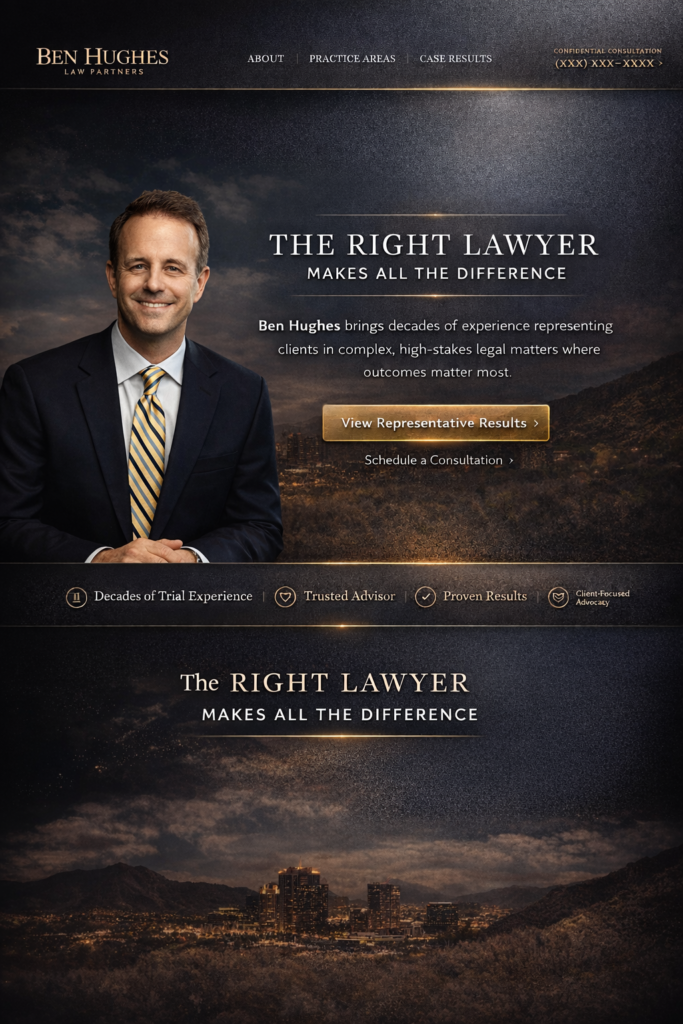
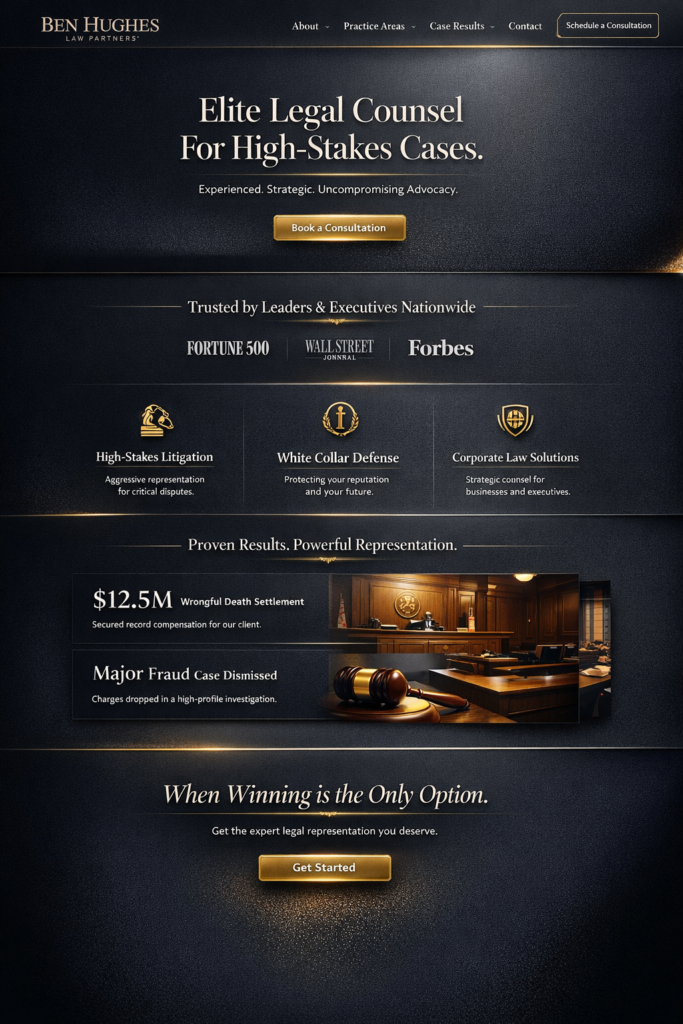
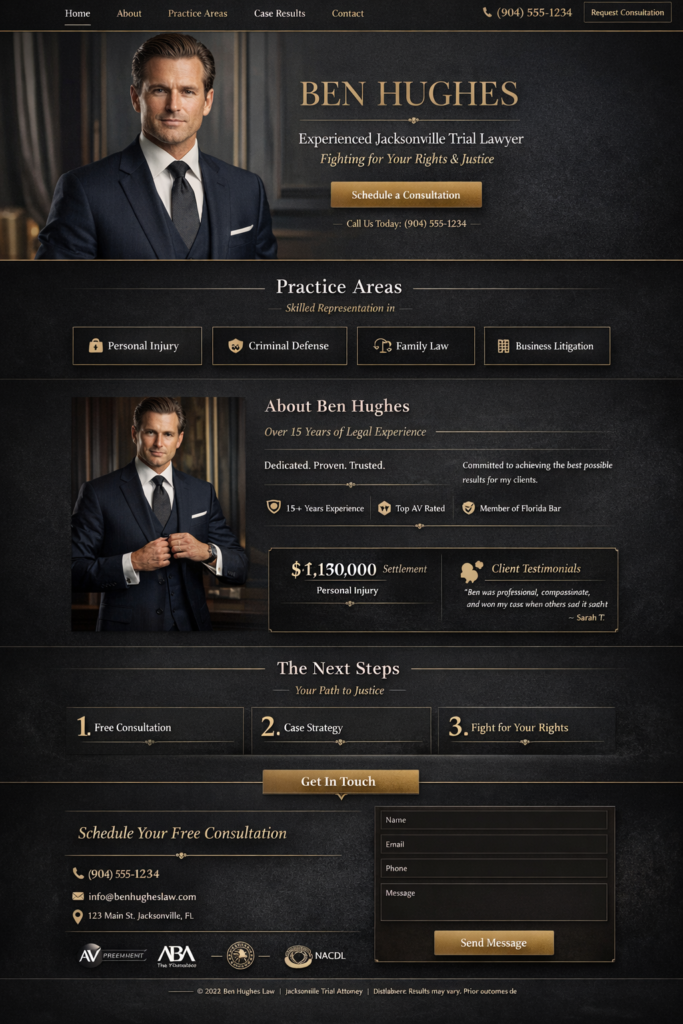
Typography is one of the most underestimated ranking and conversion factors.
Recommended Font Pairings
Serif (Authority / Trust)
Use for headlines:
- Playfair Display
- Libre Baskerville
- Cormorant Garamond
Sans-Serif (Clarity / Readability)
Use for body text:
- Inter
- Lato
- Source Sans Pro
Rules:
- Never use decorative fonts
- Avoid thin font weights
- Maintain strong contrast
- Line height ≥ 1.5
Luxury law websites feel timeless, not trendy.
Color Palette Best Practices for Law Firms
Primary Colors (Trust & Authority)
- Deep navy
- Charcoal
- Black
- Dark emerald
Accent Colors (Restraint)
- Muted gold
- Bronze
- Soft ivory
Avoid:
- Bright reds
- Neon colors
- Overuse of gradients
Luxury design whispers — it doesn’t shout.
Advanced Local SEO & GEO Optimization (Attorney-Specific)
To rank locally, your homepage must include:
- City + practice keywords in H1/H2
- Natural geographic phrasing in body text
- Location-based image alt text
- Embedded Google Map (if applicable)
- Internal links to city-specific pages
Example:
Serving clients across Jacksonville, St. Johns, and North Florida.
This strengthens:
- Google Maps visibility
- AI-generated search results
- Local pack rankings
Image SEO: What Attorneys Miss
Each homepage image should have:
- Descriptive filename
- Location-based alt text
- Contextual relevance
Alt text example:
Luxury attorney website homepage design for Jacksonville law firm
This helps image search, accessibility, and GEO SEO. What is SEO, and how to improve your website info here
Final Truth: Ranking Comes from Clarity + Authority
Attorney websites that rank and convert share the same traits:
- Clear messaging
- Strong hierarchy
- Calm luxury design
- Visible credibility
- Effortless contact access
Your homepage should feel like a confident consultation, not a sales pitch.
We hope you found this article helpful and informative. If you’re considering designing a new website or redesigning your existing site for your law practice, we’d be happy to help. Feel free to reach out to discuss your goals and explore how a strategic website can better support your firm.
Check out our Services page if you need more info about our services, or Contact Us if you have any questions.